
How James Abbott swapped outdoor instructing for Alpine distilling — and is winning over the French, one herb at a time.
When you think of the French Alps in autumn, chances are whisky, gin, and wild mountain liqueurs don’t immediately come to mind. But high above the spa town of Saint-Gervais-les-Bains, where the larch trees turn gold and the ski lifts lie dormant, a Scottish distiller named James Abbott is rewriting the Alpine rulebook.
A few hundred metres above the village, in a wooden shed that used to be a donkey shelter, copper pipes gleam and bunches of herbs hang to dry. Bottles of sugar-free génépi and wild strawberry gin line the shelves. This is Distillerie Saint Gervais — and it’s James’s life project. As of 2025, it’s also a growing Alpine operation producing vodka, sugar-free génépi, and wild strawberry infusions — all powered by a spring-fed water supply and solar electricity.
“I didn’t want to make something sweet and syrupy,” he told me during my visit this summer. “I wanted it to be about the flavour of the plant.”
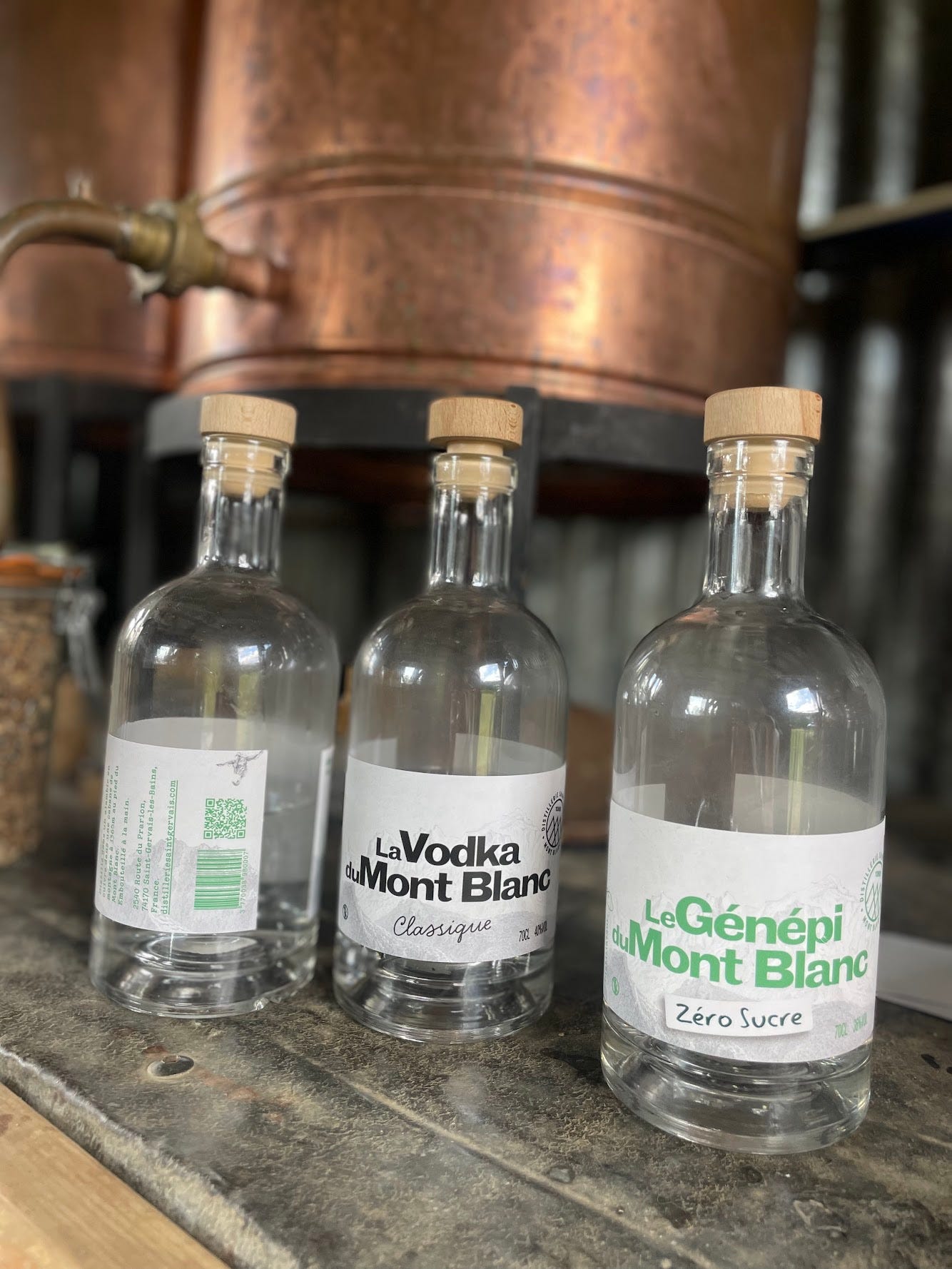
That plant is Artemisia mutellina, a small, bitter alpine herb in the wormwood family that grows above 1,800m. It gives génépi its signature punch – usually softened with hefty amounts of sugar. But James’s version is dry, complex and botanical, made in micro-batches with mountain spring water and a hand-built copper still.
From Instructor to Alchemist
Originally from south-west Scotland, James worked in outdoor education for over 20 years before shifting to distilling. “I used to guide kayaking and run expeditions — mostly in Scotland and abroad,” he says. “But this is a whole different kind of challenge.
He credits his mother — an alpinist and mountain rescue volunteer — with inspiring his path.
“She taught me how to tie a rescue knot one-handed when I was about eight,” he said. “She did all the Munros. So being outside was always in the blood.”
He first came to Saint-Gervais for a winter season, planning to stay just six months. That was eight years ago. “I did all sorts: winter guiding, helping at the bouldering wall, building stuff… I liked the area and I wanted to make something tangible,” he says.
That “something” turned out to be spirits.
“I started distilling in the back room of my apartment. I was just curious. I liked the process — the science of it, but also the creativity.”
At first, it was gin — for its flexibility with botanicals — but then someone gave James a bunch of génépi plants. “I thought: why not try it?” he recalls. That small experiment soon grew into an obsession. He signed up for a formal distilling course, dived into research, and began sketching plans for a working distillery — one that would eventually be approved by French customs and installed above Saint-Gervais in a handmade wooden shed.
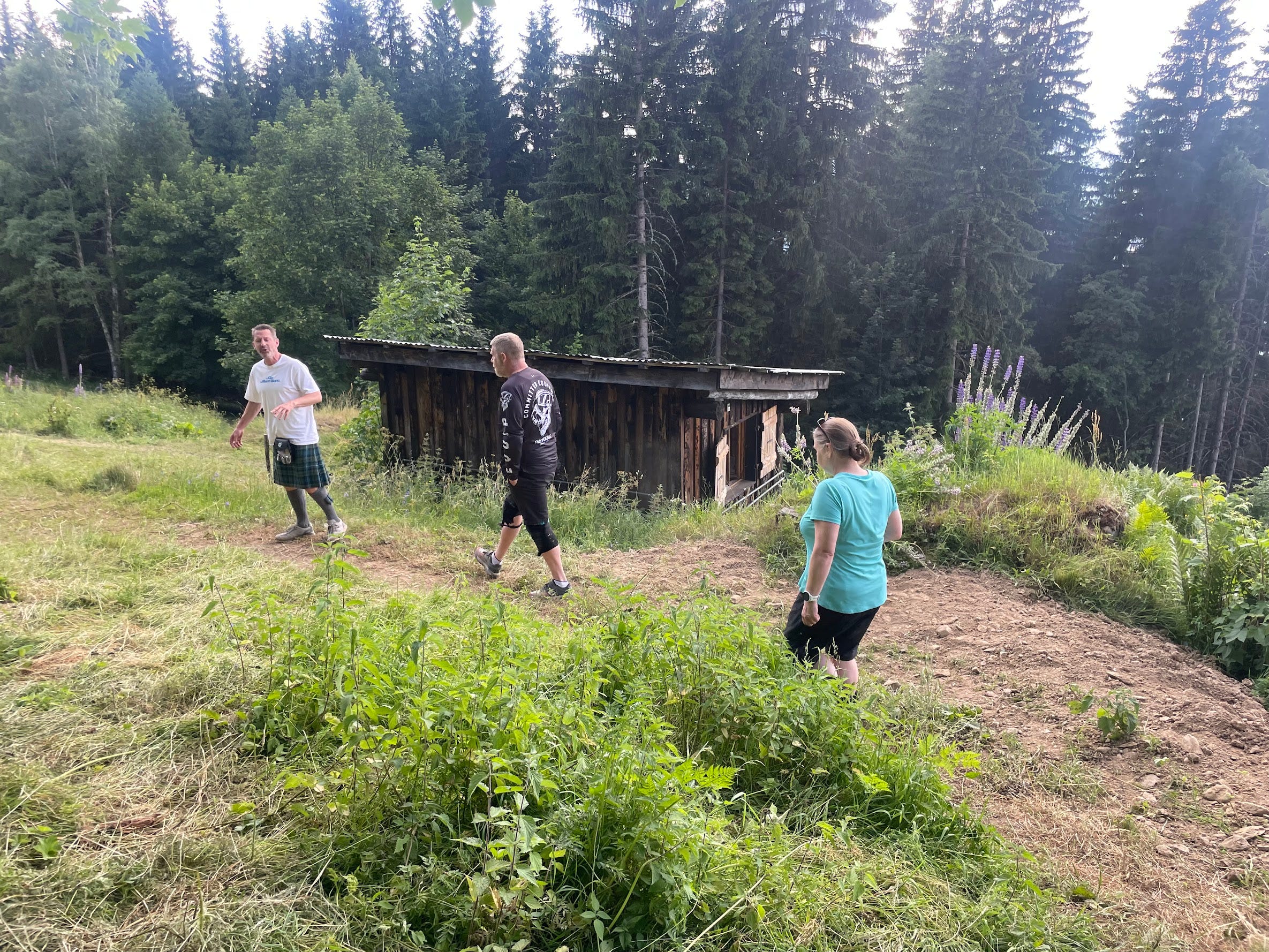
“There were a lot of hurdles,” he admits. “You’re dealing with customs, distillation laws, botanical limitations… and I’m in a national park. But I just kept going.”
The goal was always to keep it small, sustainable, and rooted here,” James says. The distillery is entirely self-sufficient in water — thanks to a nearby spring — and runs on solar energy. All bottles, caps, and packaging are made in France or Italy, using recycled materials.
The result, today, is Distillerie Saint Gervais — officially registered and, according to James, the highest working distillery in the Alps. “As far as I know, it’s the highest active distillery around,” he says of the 1,365-metre site, perched on a slope above town.
He hadn’t originally planned on any of this. “I was meant to go to Canada for outdoor work,” he explains. “But things shifted, and I ended up here instead. It was meant to be six months — and that was eight years ago.”
Reinventing a Sacred Spirit
Génépi is a traditional Alpine herbal liqueur made with artemisia flowers — part of the wormwood family. For centuries, it’s been a staple in Savoie and Haute-Savoie: green, sticky-sweet, and served in small glasses after a mountain meal. For many locals, it’s not just a drink — it’s sacred. Which makes it all the more remarkable that James Abbott, a Scotsman in a self-built shed, is daring to reinvent it.
“I’m not trying to disrespect tradition,” James is quick to say. “I just think there’s room for innovation. The French are cautious about change — but they’ll try anything if the quality’s there.”
His take on génépi breaks with convention in both taste and technique. Made using locally foraged herbs and a small copper still, James’s génépi is completely sugar-free — something he believes is a first. “It’s dry, not sticky — more botanical than syrupy,” he explains. “And that makes it more versatile. Bartenders love it. It works in cocktails, spritzes, all sorts.”
At first, this bold move didn’t exactly go down smoothly.
“I didn’t realise quite how sensitive the French would be about it,” he admits. “At the beginning, I definitely raised a few eyebrows. I was the mad Scotsman distilling in a shed, wearing a kilt in -10. They called me le fou.”
But James, who built the distillery himself with the help of friends, has stuck to his vision. “Génépi’s the star, but I’m not trying to just replicate the same old thing,” he says. “Everything I make is sugar-free. It’s about letting the ingredients speak for themselves.”
What started as a curiosity is now gaining real traction. His clear génépi — infused at times with wild strawberry or raspberry — is a bold departure from the neon-green liqueurs found in tourist shops. “People expect génépi to be bright green and syrupy,” he says. “But that’s usually packed with sugar and artificial colouring. Mine’s just herbs and neutral spirit. Nothing added.”
In summer 2025, James launched three new creations: a smooth Mont Blanc vodka made for cocktails or shots; a strawberry-infused génépi using berries from Haute-Savoie; and an ultra-dry “Génépi Zéro” with absolutely no added sugar — floral, herbaceous, and designed to challenge expectations. “We didn’t want any more sugar,” he says. “So we just put zero in.”
He offers me a taste of his No.1 — a génépi that’s crystal-clear, complex, and almost shockingly dry. “I wanted something you could enjoy slowly, like a good digestif, or mix into a cocktail. Not just a gimmick.”
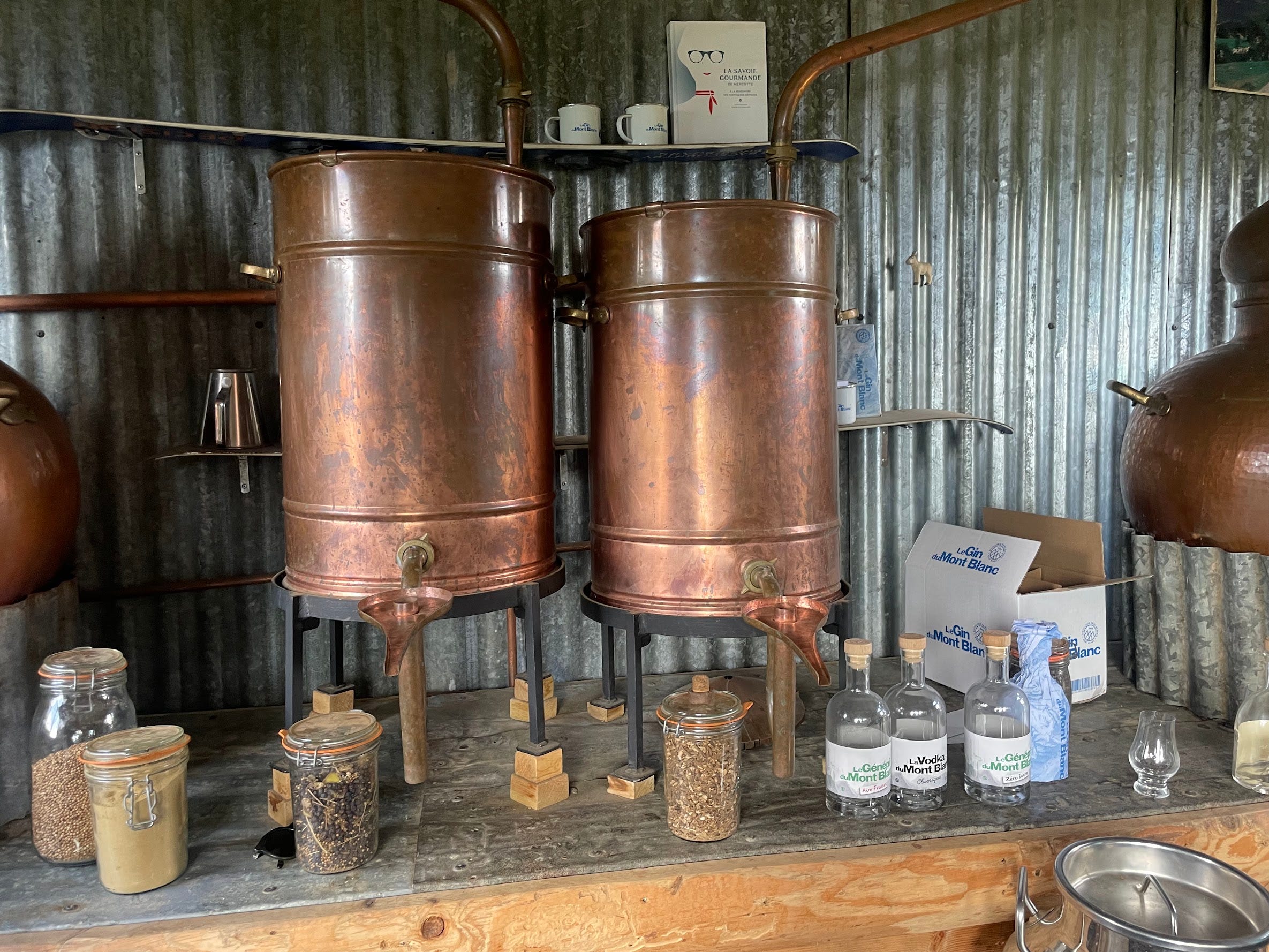
Inside the tiny wooden hut where he distills, the air smells faintly of wild herbs. Shelves are lined with jars of dried elderflower, wild thyme, alpine pepper — and, of course, artemisia. “I forage quite a lot myself. There’s stuff growing all around here. But I’m also working with a local herbalist and some organic growers in Savoie,” he says. “The goal is small-scale, sustainable, and real.”
James also makes a wild strawberry-infused gin and a rotating range of micro-batch spirits, many built around what’s in season. A lemon verbena liqueur is currently in development, along with a bitter digestif made using over a dozen herbs. “I’m experimenting all the time. I want to do a blackcurrant-leaf gin soon. And something smoky for winter.”
“There’s a reason distilling has always been connected to landscape,” he adds. “You work with what’s growing, what’s available. Autumn’s great for that.”
Despite the rustic setting — no glossy tasting room, no merchandise — the place feels more like a laboratory than a shed. Copper pipes wind across the back wall. Tasting notes and recipe tweaks are scribbled in neat handwriting. “Sometimes people hike up here thinking it’s a big production site,” he says, laughing. “And I’m like — it’s just me and a kettle.”
Running a distillery in a French national park hasn’t exactly been easy. “I did everything myself — planning permission, the paperwork, building the distillery, sourcing the stills. It’s been a learning curve. But also really satisfying. You see the progress.”
And it’s working. His spirits are now stocked in several local bars and restaurants, including La Ferme de Cupelin and the Saint Gervais Hôtel & Spa. He’s collaborated with chefs and bartenders to create bespoke infusions, and the locals — once wary — are increasingly enthusiastic.
Some of his spirits — including the Mont Blanc Gin, co-developed with renowned master distiller Tom Nichol — are distilled just metres from where they’re bottled. “Tom’s a legend,” James says. “It was amazing working with someone of that calibre. He really helped refine the gin — it’s crisp, persistent, and has that Alpine freshness we were after.”
“I didn’t think the French would take to it, to be honest,” he says. “A Scotsman making génépi? But people have been really supportive. Restaurants and épiceries in the valley are starting to stock it. Locals bring me herbs or ask to try the new batches.”
“The crazy Scotsman distilling in a kilt, in minus ten,” he jokes again. “But once they tasted it, they got it.”
He pauses. “The French can be very traditional, especially with génépi. But if you respect the base ingredients and do it well, they’re open. They just don’t want you to mess around for the sake of it.”
I visited in early summer, e-biking up from Saint-Gervais through pine and larch forest. It’s a great off-season activity — and in the autumn, it’s even better. No ski lifts, no crowds — just golden trails, stillness, and sweeping Alpine views.
Outside the distillery, late summer wildflowers edged the trail, and clouds swirled around the Bionnassay Glacier. The view stretches across the Val Montjoie — a peaceful spot James says suits his rhythm perfectly. “Autumn’s probably my favourite season,” he told me, stepping into the sunlight. “It’s quiet. The colours are incredible. The air changes. And you get time to slow down and really experiment.”
The space itself is part of the story. The walls are timber-clad and hand-built; the floor was levelled with a shovel and a spirit level. A small shelf holds notebooks, herbs, and distilling manuals in French and English. There’s no shopfront, no QR code signs — just James, a copper still, and a willingness to share.
“I want it to feel approachable,” he says. “Distilling shouldn’t be this big mysterious thing. It’s something people can understand and get involved with.”
He’s also quietly expanding the experience side of the business. “If someone wants to come up, taste a few things, see how it’s made — I’m always up for that,” he says. “We’re going to start doing workshops — ‘make your own gin’ days, herbal distilling courses. I think people are craving hands-on experiences, and we’ve got something really unique here.”
James is planning to offer more in the coming year: distilling courses, botanical walks, and tasting sessions where visitors can smell the herbs, see the process, and sample the results. “People want to get hands-on,” he says. “It’s not just about drinking — it’s about understanding where these flavours come from.”
Local response has evolved from scepticism to support. “Some of the old farmers come round now and bring me things — plants, advice, stories about how their grandfather used to make it,” he says. “It’s really special. I’m not trying to replace tradition — I just want to bring something new to it.”
He picks up a small bottle filled with pale pink spirit. “This is my raspberry génépi,” he says. “I macerate the berries fresh and leave them just long enough to keep the sharpness. It’s amazing with dark chocolate.”
Asked what’s next, he shrugs. “More experiments. More flavours. Maybe a book. And I’d love to collaborate with local chefs on pairings. But for now, I’m just enjoying the process.”
Why This Matters
Distillerie Saint Gervais isn’t just another stop on the Alps’ booze trail — it’s part of a broader shift towards small-scale, place-based production. Like the cheesemakers, brewers, and herbalists who’ve quietly sustained mountain economies for generations, James is creating something rooted — and rare.
“There’s something about doing this up here,” he says. “It’s not easy. But it fits.”
The transition from outdoor educator to micro-distiller might sound drastic, but to James, it’s part of the same thread. “With guiding, you’re trying to create an experience — something memorable,” he says. “This is kind of the same. Except now I get to bottle it.”
Whether you stumble upon his shed on a forest trail or plan a tasting stop into your Alpine escape, you’ll find more than génépi inside. You’ll find a bit of Scotland, a lot of the Alps — and a man happy to be called le fou, as long as the spirit’s good.
How to Visit Distillerie Saint Gervais
Location: Above Saint-Gervais-les-Bains, Haute-Savoie, France
Access: Reachable by foot, car, or e-bike (recommended in off-season). Ask locally or contact James via his website for directions.
Open Days: Held periodically in summer and early autumn.
Workshops: Launching soon – check for updates on Instagram or distilleriesaintgervais.fr.
Spirits: Available locally or for delivery within France.