
It’s not just tourists who come to dine in Hotel Dieu and share a drink under its 32-meter-high dome. The former 12th-century hospital still holds many good memories for Lyonnais, who also enjoy its new offerings.
It’s said that one out of every three Lyonnais was born in the Hotel Dieu, which became an actual hotel in June 2019 after it ended its 800-year tenure as a hospital in 2010.
That was also the year that the ‘Gastronomic Meal of the French’ was added to UNESCO’s Intangible Cultural Heritage of Humanity list. A fitting time then, to revamp one of Lyon’s most iconic buildings into a place locals, as well as tourists could enjoy.
For many, the hotel holds fond memories; “Several Lyonnais have asked to sleep in the room where they had their babies,” says Marion Sardou, the hotel’s marketing and communications manager.
They clearly have a special relationship with the former hospital which was fully functional by 1454 and became one of the most important in France. It’s why the building was officially classified as a historic monument in 2011.
Many of the doctors and nurses who once worked there were moved when they saw the result of the largest private renovation project carried out on a historic monument in France.
Traces of the past
Everywhere you go there are reminders of the building’s former function. From the painted wooden beams which were freed from their concrete shells, the stone floors modelled on an 18th-century style, to the corridors with their original pillars. Even the lampshades resemble nurses’ hats.
“Several Lyonnais have asked to sleep in the room where they had their babies”
Marion Sardou, Marketing and communications manager, Hotel Dieu
The 300-meter-long building has 144 rooms, including 44 suites, half of which have a view of the Rhone and the other half a view of the historic complex and its two domes. Downstairs it is divided into two main areas, its entrance being the former hospital’s entrance, with the 18th-century doors fully restored.
In the reception is a library of genuine medical books from the 18th and 19th centuries which were found here – although don’t try to read them, clearly doctors’ handwriting was just as indecipherable in previous centuries.
Whilst the building is prestigious on the outside, the interior is simple. Indeed, many of the renovation details are inspired by this dichotomy. The screens which divide up open spaces in the long, thin building, are decorated with embroidered silk combined with whorls made from the black ropes that silk workers used: raw modest materials juxtaposed with something precious and special.
As we head down for lunch, Marion tells me that at least 80 per cent of customers at the hotel’s Epona restaurant are locals, making it feel unlike a hotel restaurant at all.
Dining like a Gallic goddess
Named after one of the most revered Gallo-Roman goddesses, a protector of travellers and horse riders, Epona is also a nod to the days when the building served as the “Confrérie des frères pontifes” a pontifical meeting place and refuge for both travelling and local members of the clergy.
We begin with an amuse-bouche, the Cervelle de canut or “grumpy silk worker’s brain.” A speciality of Lyon, but on this occasion, the creme cheese is from Normandy, like its chef Mathieu Charrois.
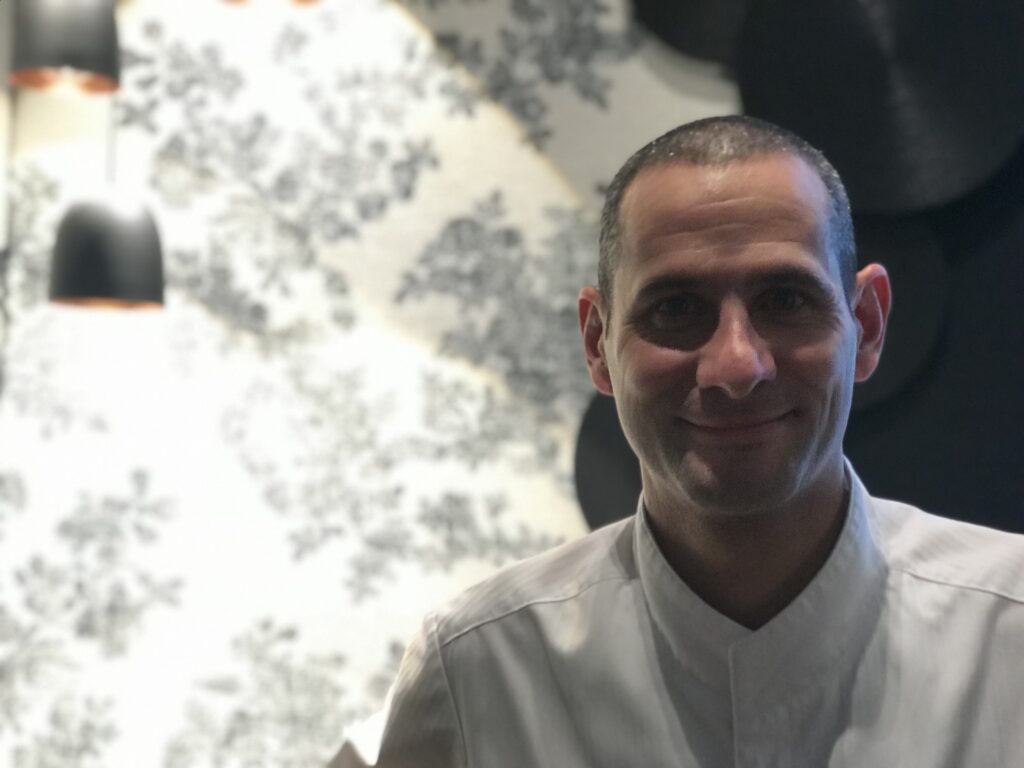
The Lyonnais cuisine with a twist theme continues, thanks to Mathieu having worked all over the world: after a few years with Michel Troisgros at the Lancaster Table in Paris, he went to Polynesia, then returned to join Yannick Alléno’s brigade in Courchevel, before heading to Beirut, Marseille, New Caledonia and London.
I opt for the 29 euro menu of the day, which changes daily, and my first dish arrives looking like a delicate pastel drawing. An Octopus terrine with Chinese cabbage and a bright green jelly sauce made from fried parsley.
“Lyon can be expensive to eat out,” says Marion “so we made sure we weren’t overpriced as we wanted to target local people. We are not trying to be a Michelin star restaurant, we are always open, 7 days a week and Mathieu also wanted to create a generous cuisine with the idea of sharing.”
Hence the signature dish, the Cocotte – various casseroles, served in a pot, such as a fisherman’s catch, poulet de Bresse (France’s most prized chicken) or saddle of lamb.
My main course of beef boiled in beer from the north of France arrives. It melts in the mouth and is perfect for a rainy autumn day like today.
There is also an à la carte menu which changes every four months. Their signature starter, the K’nelle is a stuffing of white fish with New Zealand spinach and manta crayfish sauce. But this is crisp, not moist all the way through like the traditional poached creamed fish of the Lyonnais Quenelle.
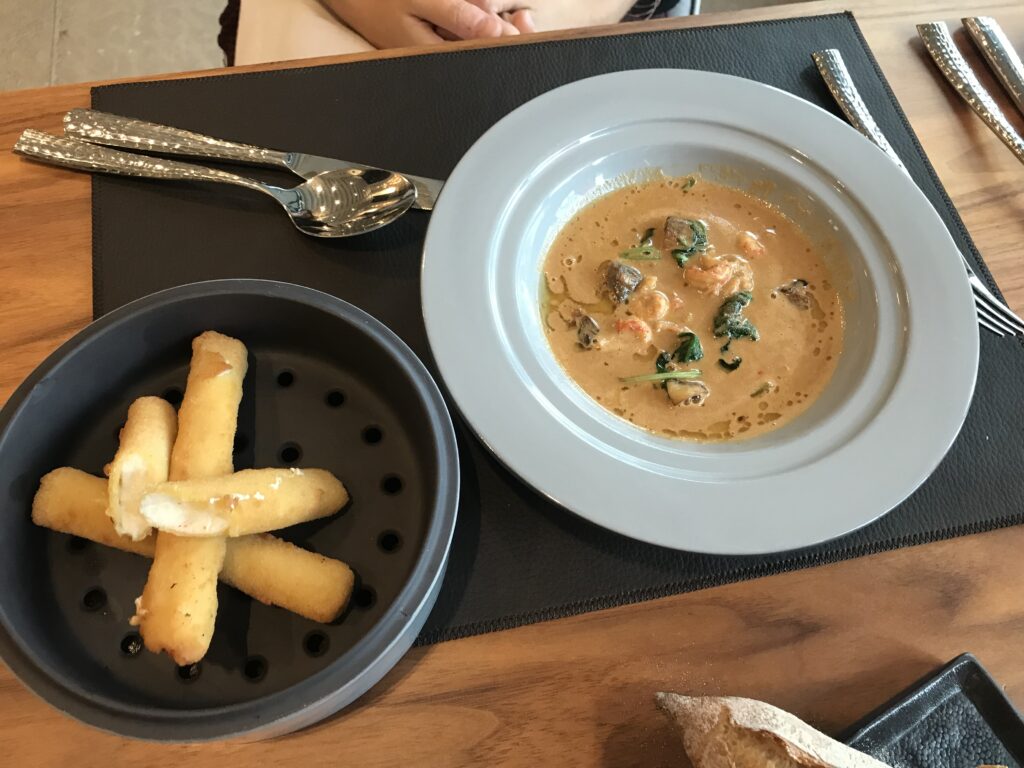
Other options include a frog and snail dish but combined with cacao nibs rather than the usual garlic drench, or a Lyonnais-style calf’s head and foot with fennel sauce. But there is also a vegetarian option and everything is gluten-free and local, as they work a lot with the producers in the Halle next door.
For dessert, we share a mango curry sorbet within a taco of coriander rice milk with coconut – the patisserie chef is a big fan of India, apparently, and it really works to elevate the mango from being too sickly sweet. Then there’s the dome-like “Le Rocher”, a decadent ball of Jivara mousse, a runny praline fondant centre and a hazelnut streusel, which I’m told will soon feature on the new afternoon tea menu. After all this I will need a nap, I think.
Drinks under the Soufflot dome
And from one dome to another. A visit to the Hotel Dieu would not be complete without a drink below the building’s iconic 32-metre-high Soufflot dome. Completed in the 19th century, it was partially destroyed in World War II and rebuilt in the 60s.
The Dome bar is still divided into four areas, following the shape of the former altar. Around the bar are scriptures of people who bought beds for the hospital, and many Lyonnais can find the names of their ancestors on the walls.
At the time the dome shape was an advanced building technique and functioned like a chimney to suck out germs and get rid of bad air.
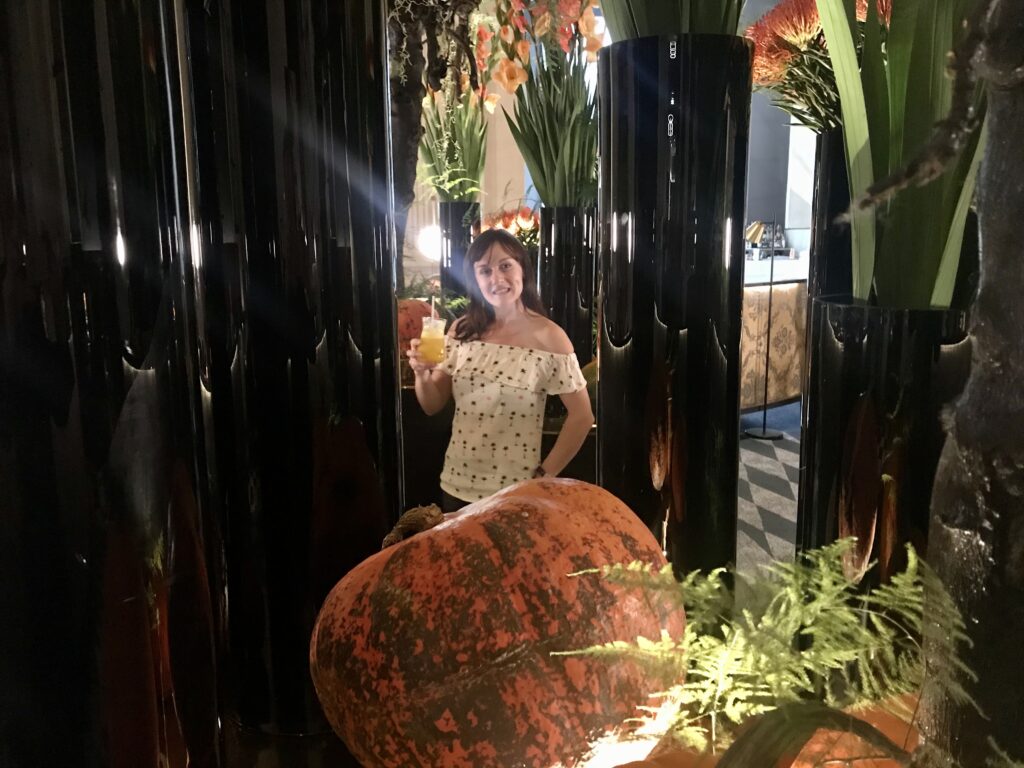
I stood directly below it and gazed up at the awesome structure above, with a Kiwi Chartreuse Tarragon cocktail in hand. Combining the old with the new, the cocktail blends yellow and green Chartreuse with kiwi. There’s also the signature cocktail, mixing Lyonnais pink praline with vodka, pink champagne and lemon, aptly named, the Dome.
This article was published in This is Lyon in 2019.