
I’ve decided to republish some of my earlier articles that may not be easily found online anymore. Here I explore one of the lesser-known regions of France, Franche-Comte.
Enjoy!
Better known for its famous yellow wine, laughing cow cheese and as the birthplace of chef, Raymond Blanc and author Victor Hugo, Franche Comte is still a relatively unknown part region in eastern France. Bordering Switzerland, it’s dense with pine forests, rolling mountains, and waterfalls. Also known as “Little Scotland,” for its numerous lakes, it’s the perfect destination for foodies and outdoor types alike.
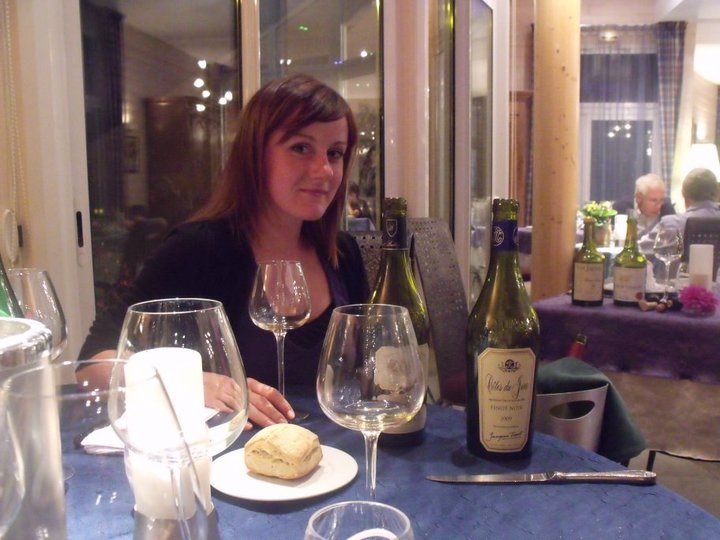
Glimmering pale golden yellow like the limestone rock faces of Baume-les-Messieurs, in the Jura region of southwest Franche Comte, I sip a glass of the famous vin jaune or ‘yellow wine.’ My expectations are high, as recently an amateur wine group paid a record €54,000 for a 240-year-old bottle containing grapes harvested during the reign of Louis the Sixteenth. Mine is a much younger bottle but still has the characteristic hints of fortified sherry, nut and straw. Made from the local Savagnin grape, it acquires its characteristic yellow colour and unique flavours as it is filtered through straw and aged for the required time of six years and three months.
I’m dining at “Au Verbe Aimer” restaurant in La Parenthese Hotel, set in the heart of the Jura region. Their cellar has over 120 wine selections, so I’m sampling a different one with each course; from a 2004 Cotes du Jura made with a blend of Savagnin and Chardonnay grapes, an Arbois pinot noir, a deep purple 2009 Rouge Vermeil, all the way through to a 1955 bottle of Cotes du Jura. As I sip my yellow wine I’m encouraged to taste local cheeses like the creamy Cancoillotte, an almost liquid cheese made from “metton,” a raw curdled, milk, that’s skimmed and heated, with a little garlic or white wine added. Apart from Laughing Cow cheese, the region is also well known for varieties like Comté and Morbier, which is striped with a black layer of wood ash.
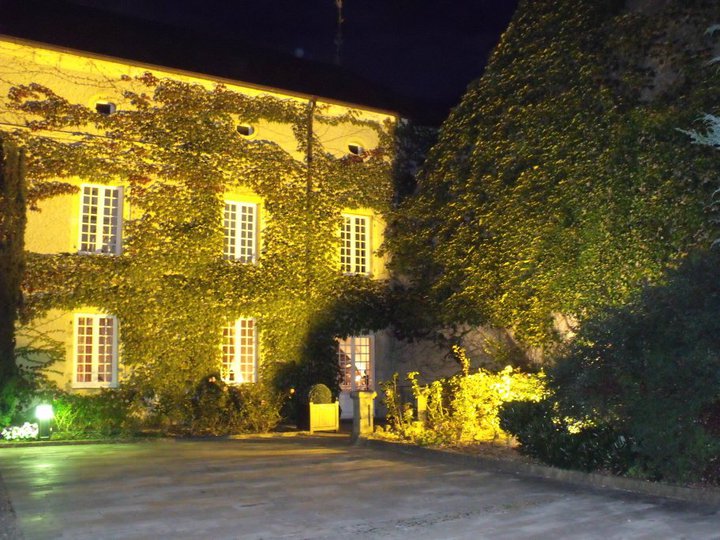
From La Parenthese Hotel you can visit Château-Chalon, one of the first villages to be granted an appellation contrôlée, and where only Vin Jaune is produced. Classified as one of the most beautiful villages in France, you can visit the remnants of its 13th-century castle and the ancient fortified gateway to the town and wander around Chateau-Chalon’s vineyards which date back to Roman times. Vin Jaune is very much celebrated in the region and every February the festival “La Percée du Vin Jaune” (Opening of the Yellow Wine) is held for the newly released vintage. The event takes place in a different town each year, in 2010 it was hosted Poligny, where Louis Pasteur carried out many of his experiments and in 2011 it was Arbois.
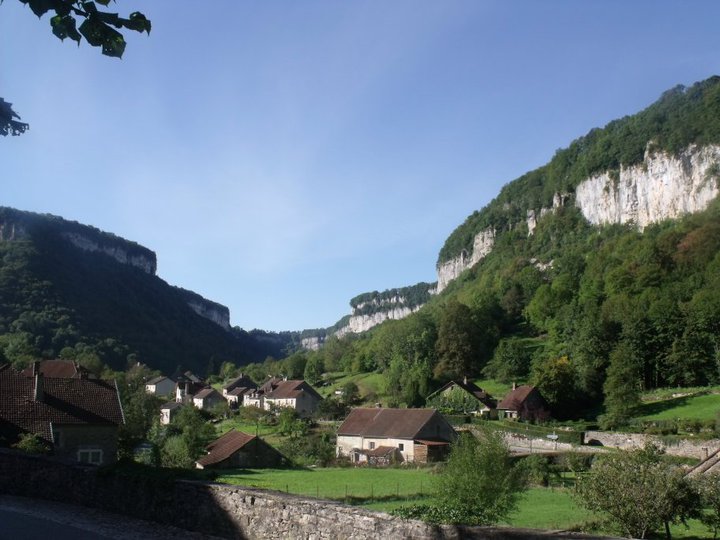
But the Jura is not all about wine. The Jura Mountains themselves (Jura, meaning forest mountains) are perhaps not as majestic as the Alps but are more accessible and provide France’s first cross-country skiing area, as well as caving, climbing, horse riding, hiking and mountain biking. Head east from Chateau-Chalon, and you come to Baume-les-Messieurs, a picturesque village at the end of a large gorge. Surrounded by steep wooded slopes, rising to high cliffs is the Cirque de Baume, its the meeting place of three impressive valleys.
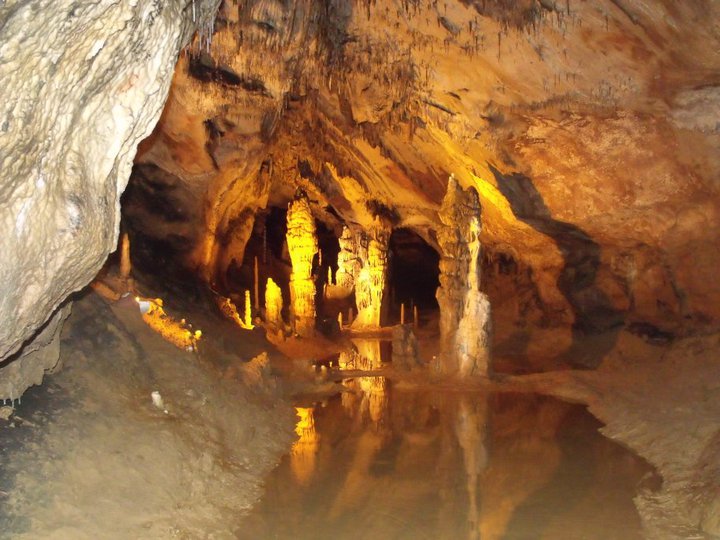
Close by is the Grottes de Baume and the Tuffs’ Cascade. As we climb towards the entrance of the cave we pass under a “ponytail” of water, shooting out into the air. The jet of water is only formed when levels in the cave get high and is diverted out through a tight hole. Inside, Jurassic limestone stalactites fill the cave’s cavernous ‘rooms’ They are carefully lit, and I spot some graffiti dated from 1876. I can hear the odd flutter of a bat, and our guide tells us they are so used to people they sometimes bump into them as they’ve switched their radar off. There are also small blind shrimps in the puddles which eat the bat excrement. They have no predators here so can live for up to 20 years. The highest room is 71 meters high and is a crack created by the formation of the Alps. It has good acoustics, so it’s called the festival room and classical music concerts have been held there. Our guide switches on some music and it reverberates around the room, bouncing off the organ-shaped stalactites.
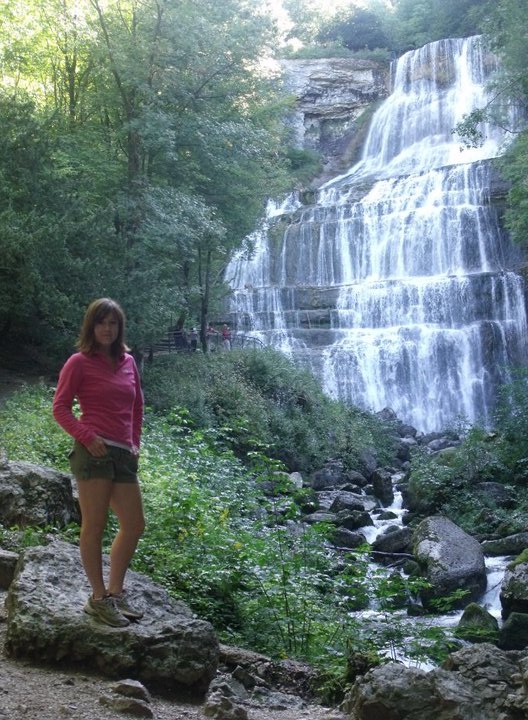
Heading south from the Baume-les-Messieurs you reach the stunning Hérisson cascades. Formed as the river of the ‘Hedgehog’ descends 805 meters, creating a series of 31 jumps and seven waterfalls, the most famous being the Eventail at 65 meters and the Grand Saut at 60 meters. The whole route can take around 3 hours to walk ( over 7km) but it’s not circular, so you can walk up to as many of the cascades as you have the energy for and then turn back. The tumbling waters get more and more impressive as they crash down, one after the other as the Herrison River pulses on, before crossing the lakes of Val and Chambly. We park at the bottom of the falls and walked about halfway. At the second fall, you can cross and go behind it. Arriving at the halfway mark, the river is calm and you can take a dip.
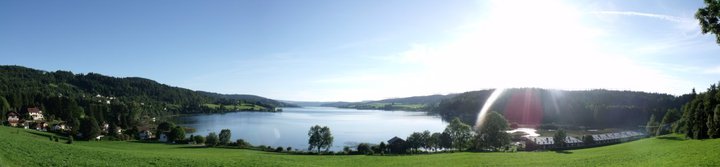
Near the town of Le Frasnois’ Aeolian, we stop for lunch at the L’Eolienne, (the Wind restaurant.) overlooking the Espace botanique du Frasnois, a botanical garden created in 1997. There is also a nature trail and an indoor exhibit of the region’s plants where you can learn about the therapeutic qualities of over 300 herbs and medicinal plants. During the winter this area becomes a ski resort, Les Rousses, which is part of the Haute Jura cross-country domain and has over 220km of trails. Nearby is the Belvedere des 4 Lacs, with magnificent panoramic views over the clear, calming waters of Lacs d’Ilay, de Narlay, du Grand and du Petit Maclu. Then there’s Saint Points Lake, the third natural mountain lake of France, where you can fish, paddle boats, windsurf, sailing and swim.
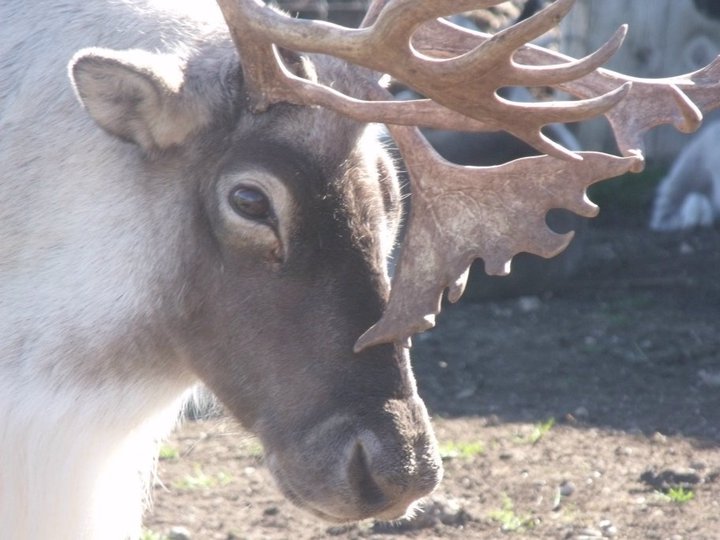
A visit to the Jura region isn’t complete without a stop at the Chaux Neuve’s Polar Park. Although it seems unlikely on a mild Autumn day, the Polar Park is set at 1200m altitude and is known as “The French Little Siberia.” I was apprehensive as we began our tour of the park, but the guides are specialised animal trainers, so I eventually relaxed as we walked amongst the herds of Reindeer, Western Tarpan horses, aurochs and yaks.
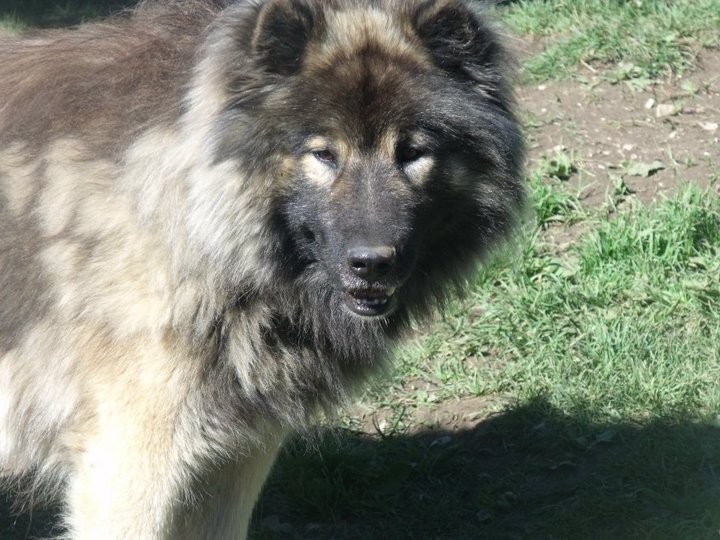
But entering the area where the pack of Greenland Eskimo huskies lived I felt nervous again. The dogs are said to have taken over the behaviour of their ancestor, the wolf, and despite generally lazing around, every now and then they’d get into frantic play fights with their brothers and sisters, rendering me frozen to the spot. However the toddlers also on the tour had none of my concerns, giving them a pat when the dogs became curious enough to approach us for a nuzzle.
The idea behind the park was to protect the flora and fauna of cold areas which are disappearing from regions like the Jura. I am shown a video of founders, Claude and Gilles Malloire, who left Franche Comte in 1989 to live on a secluded farm in Greenland. With temperatures reaching minus 45 degrees in winter, and no electricity or water, they were completely self-sufficient. But it became a lifestyle they wanted to help defend, and share, so they came home and developed the park.
Franche-Comté is still a lesser-known part of France, but it has many natural wonders and famous produce, which we may not have realised come from the region.
Where to eat
L’Eolienne, (The Wind restaurant)
A set menu featuring local produce, for € 22 included a Comte crumble or crude salad, lamb or fish, lamb shank mouse and a blackcurrant tart or chocolate mousse cake. Jura wine for € 4.
Au Verbe Aimer
Set in La Parenthese Hotel, Au Verbe Aimer offers cuisine inspired by the land and local produce. The A la Carte menu has a variety of dishes such as Pumpkin Veloutte, Bresse Poulty Vin Jaune and morel Mushroom cream, Duck with Foie Gras Terrine. All are accompanied by a selection of Jura wines.
Where to stay
La Parenthese hotel is an 18th-century mansion set on the hillside of Chille village, this spa hotel has 34 rooms as well as spa facilities, a restaurant, and an open-air pool.
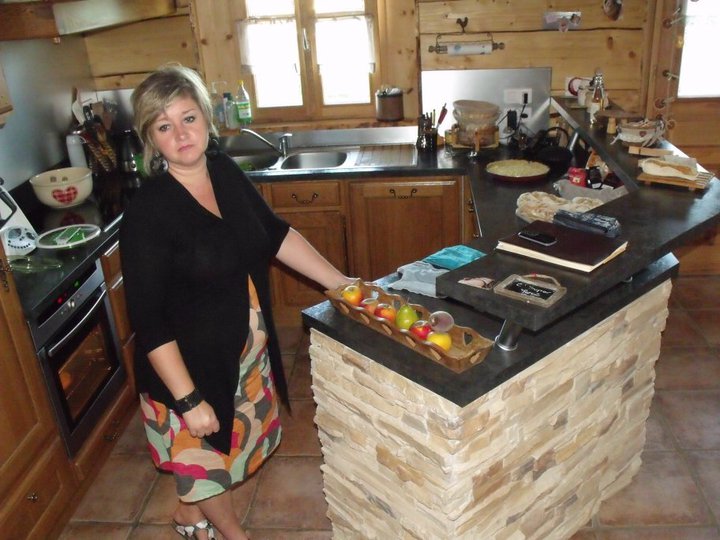
Chant du Coq Hotel in Dommartin is a charming farmhouse-style chalet made of spruce. It’s located in the Doub region but has easy access to the Jura, nearby Poligny and the capital Besacon. Set 5km from the cross-country skiing area of Larmont and Saint Points Lake, Le Chant du Coq guest house was built and is run by Celine who lives nearby and pops around to prepare a hearty breakfast of bread, yoghurt, pastries, and homemade jam. She can also prepare a dinner of local specialities if required.
Activities
Dommartin is a small quiet village, crossed by the river Drugeon. The nearby town of Pontarlier offers a wide range of sporting activities as well as being part of the long-distance Nordic ski trail, the Grande Traversée du Jura.
This article was first published in 2011