
Winding between the slender Larch trees in knee-deep power with just enough space to twist and glide through their spindly path. It’s as if the seedlings were planted with the off-piste skier in mind. While it feels like the tree-lined skiing of Canada, this is France’s Southern Alps.
This article was first published in 2011.
Normally the Larch- or Mélèze – do not survive above 2000 meters, but the influence of the Mediterranean is obvious in Risoul, one of the largest ski resorts in the Southern Alps.The Larch trees grow tall and strong here above this altitude.
Babette, my guide from the local ski school, points out the drag lifts to the right of the resort that take you up to the runs by the trees. There are lots of these types of lifts here, but that shouldn’t put snowboarders off, as the reward is in the deep tree-lined power. Babette explains that ‘Risoul’ means ‘sunlight,’ and Larch trees, being southern pines, need plenty of it, so it’s no surprise there are over 900 thousand of them here. I’m also promised that there is sunshine across the entire valley, 300 days a year.
Yet the Southern Alps were almost not named so, as it associates them with balmy days, vineyards and the Cote d’Azur, rather than deep powder, chalets in the mountains or chi-chi aprés-ski. But two hours north from Provence and you’ll realise the association is misleading. For many living in Provence, it is no secret that the foothills of Europe’s biggest mountain range can also offer great skiing and all winter long locals make the most of the nearby resorts.
When we arrived at Marseille airport it was 63 degrees. But in Risoul there had been a heavy dump of snowballs, the size of a child’s fist. The main difference with the northern resorts like Chamonix, Megève or Méribel is that the weather is more consistently good, with bluer skies and warmer peaks.
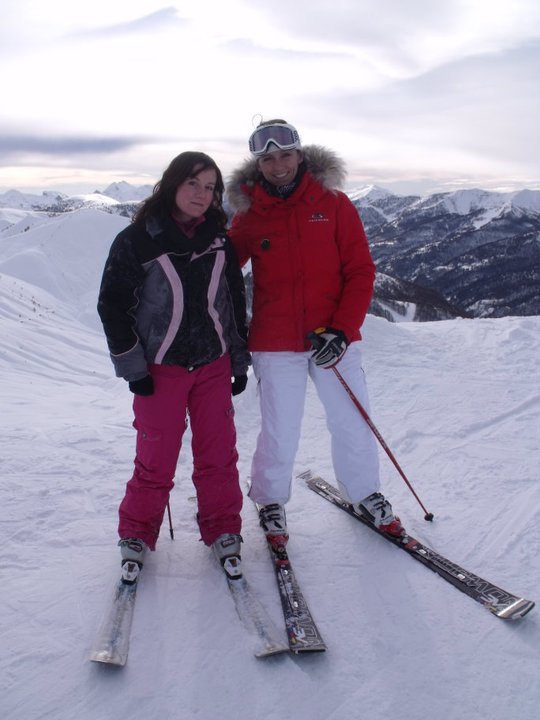
The mountain village of Risoul (or Risoul 1850 as it is 1850 meters above sea level) is in the heart of the Haute Alps, between the towns of Briancon and Gap. From various points, you can see views across the whole of the Alpes-Maritimes and the Haute-Savoie, from the Ecrins to the Queyras national park and from Mont Viso to Mont Blanc.
As we swoop through the trees, Babette tells me that the neighbouring resorts of Les Orres and Vars are flatter on top, which has its benefits, but the trees are not so tall. Here in Risoul, the dry climate and the mainly North Face slopes, with some nearly topping at 3000m, make the snow very reliable and great for morning spring skiing. You can connect with the sunnier slopes of Vars via Pointe de Razis and the lower Col des Saluces and almost all the runs return to the village so it’s practically impossible to get lost
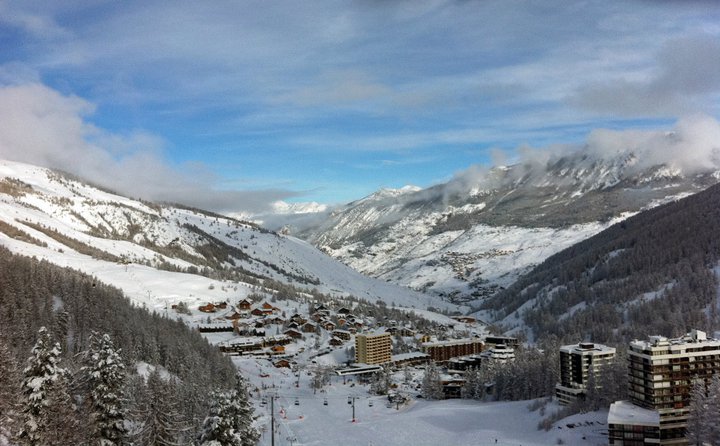
There is also a comprehensive system of artificial snow coverage across the 185km of runs. Accessible by 55 ski lifts, including one cable car and 14 chairs, they are well-pisted, wide and sweeping, with slopes inclined between 30 and 50 per cent, perfect for the average intermediate, British and first and second-time skiers and families. Unlike many northern resorts, the pistes are also pretty empty, even at weekends, leaving you plenty of opportunity to practice your carving.
Babette stops by a gate leading to a tempting off-piste area. Every morning her husband sets out early and checks out the avalanche risks in these areas. Four special zones are set up a day with clear markings and a mandatory gated entry point, via the groomed run and information on the possible level of risk. If the gate is shut, then there is an avalanche risk. It’s a unique way to make off-piste skiing a little safer. I can see that Babette clearly wants to plunge through the gate, so I let her zig-zag down, and meet her where the piste joins the powder. I learnt my lesson earlier that it was too early in the season for my rusty legs.
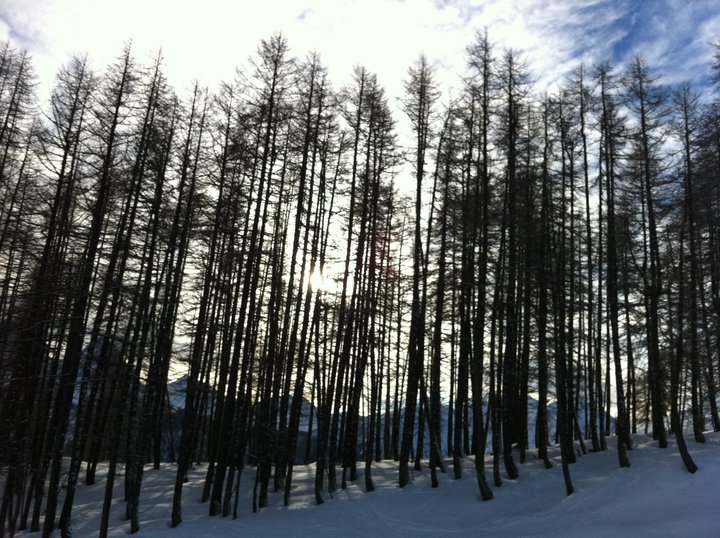
For boarders there is also a snowboard park in Vars under the TS Crevoux chair lift and Surf land in Risoul which features an Olympic-sized half-pipe, and for those looking to make their first jumps there’s the Espace Freestyle park. There are also 45 km of cross-country skiing routes, 35km for snowshoeing a Luge, snowmobiles, ice skating rink, dog sledge outings, Ruisseling ( frozen river walks) and paragliding.
The trees give the ski area its name- Le Forêt Blanche- which stretches over more than 600 hectares with altitudes between 1600-2759 meters and interconnects Risoul with Vars by lifts between the two resorts. The skiable area of le Foret Blanche is located across from the La Meje glaciers between the rivers Durance and Ubaye and has views of the Mont Blanc from the peak of the Chabrieres in Vars.
We stop for lunch in Le Valbelle mountain refuge, which offers a range of specialities of the area, such as steak and chervil, potage and the highlight; a range of crepes at prices comparatively cheaper than northern French resorts, You can also dine in their new Mongolian yurt that’s been built on the terrace.
The Larch forest also provides the characteristics of the mountain village, with the wood and stone facades of the residences and chalets. The nearby resort, first opened in 1977, is compact and purpose-built, but still attractive with many traditional chalet-style buildings and a genuine French atmosphere, set among the trees. The plaza at the end of the slopes adds to the friendly atmosphere. It’s bustling with people at the bars, creperies and restaurants. But it’s not too busy here with just three ski schools; the French ski school, Ski Cool and Snow Satisfaction.
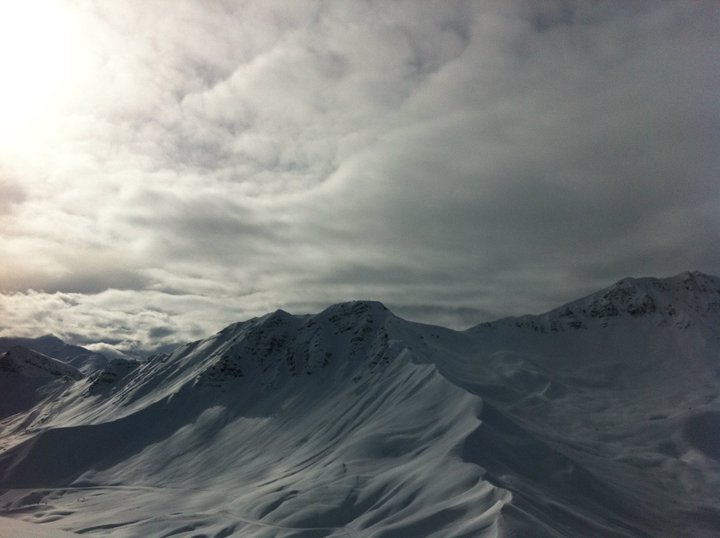
The lack of large hotels in southern resorts means that the tour operators, who tend to bring large groups and lots of revenue are reluctant to come here. But this means fewer tour groups mean more intimacy and the possibility of getting to know the people operating the ski lifts or working the bars. Another plus is that you can find great deals if you do want to stay, especially midweek and outside of holidays.
The resort also doesn’t offer the usual catered chalet; there is a choice of small hotels and new self-catering residences which are built with pools, saunas and body treatments. The residences pay very close attention to being ecologically sound. I am staying at the SARA residence, ‘Antares, ‘ where my balcony was built onto the outside of the building to prevent heat loss and there are solar panels which heat 50 per cent of the water.
In Risou, SARA manages 13, 2,3, or 4 star apartments and offers packages including accommodation and ski lift passes. You could also try the 4-star Residence Les Balcons de Sirius at the upper end of the resort, with direct access to the slopes and offering a Spa with a heated indoor swimming pool, sauna, Jacuzzi, fitness room and body treatments.
When staying in a self-catered residence you should try doing as the locals do and head for breakfast at a nearby café. You can enjoy patisserie for breakfast then head straight onto the slopes.
Alternatively, you stay outside of the resort at one of the 17 hamlets dotted along the valley. Situated between 900-1300 meters in altitude, the villages date back to Gallic times and are French through and through, with none of the demographic in-balance that has turned places like Chamonix, Méribel and Val d’Isère into Little Englands. This is Provence with snow.
Nightlife in Risoul is also less lively than the usual après ski of the northern French Alps, Head next door to Vars for the liveliest experience. In Risou there are two discos and 3 pubs with music, but that means there is more incentive to try something different, so I took a nighttime snow-mobile ride to discover the ski area ‘by night.’ Burning around the slopes, I quickly learnt not to put my foot down too forcefully, these ski-doos are more sensitive than they appear.
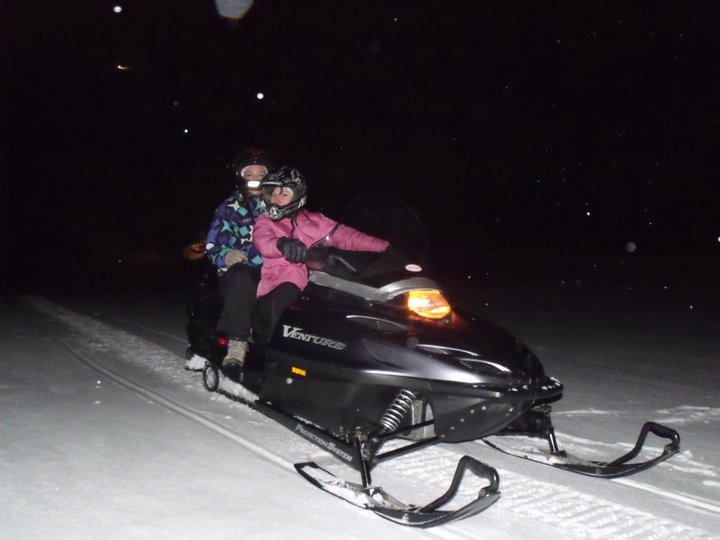
This left me sufficiently hungry for my meal at L’Extrad where I was served the hugest pork dish I could have asked for. You can also try traditional Alpine fares such as fondue, raclette and pierrade and with average prices of around €15, its considerably cheaper than many more well-known resorts. There is a good selection of local wine and cheese too.
For the past few years, the best snow conditions in the whole of France have not been found in Les Trois Vallées or Val d’Isère but in the Southern resorts, which are slowly gaining the reputation of being the country’s sunniest and snowiest, caused by the damp winter winds off the Mediterranean causing a large amount of snow to fall on the high peaks of the Southern Alps at times when the northern Alps get very little or nothing at all. As the locals say, in Risoul you’ll have your “feet in the shade, head in the skies”.
Getting there.
By car: From Paris- 770km
From Marseille, 250km via highway A51 to La Saulcec, then follow the road to Tallard and Briancon, via RN 94 to Guillestre.
From Guillestre: 15km along a mountain road to Risoul.
By Bus: Services from the bus stations in Aix en Provence, Marseille and Nice.
By Train: Gare de Mont Dauphin direct from Marseille or Paris then transfer (18km) by car or taxi to Risoul.
TGV high-speed links from Paris to Valence, Grenoble or Aix TVG
By air: From Marseille, it takes just 2 hours from London. Every Saturday the shuttle “Navettes Blanches” provides the transfer to Risoul from Marseille airport. Grenoble, Nice and Turin are also near.